
 <\/div><\/div>
Vietnam's Industrial Giant Becamex Initiates Strategic Transformation: Path of Massive Investment, SOE Reform, and Value Chain Upgrade<\/h1>\n
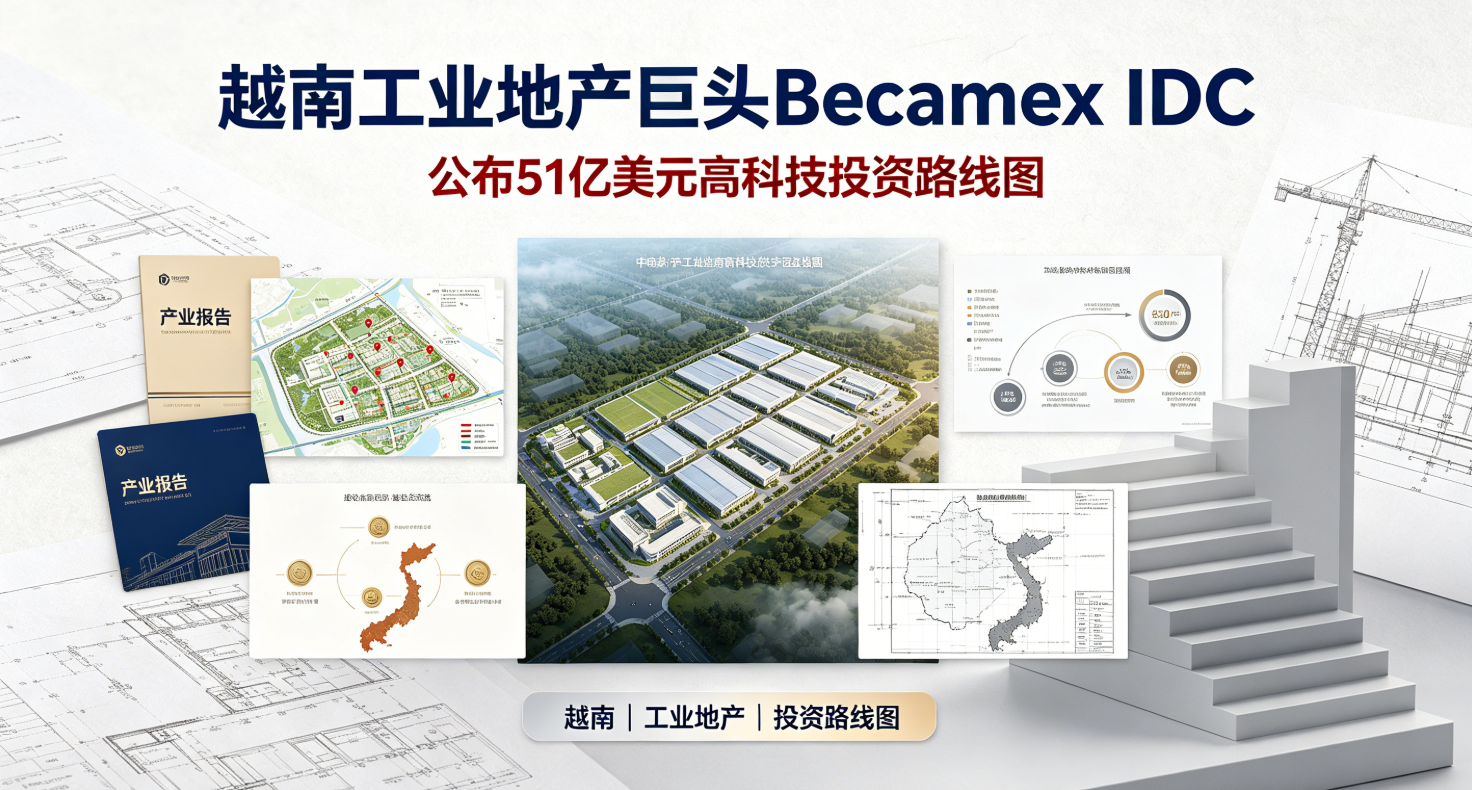
Amid global supply chain restructuring and regional economic integration, Vietnam's industrial real estate leader Becamex IDC held its annual general meeting on June 26, 2026, unveiling its 2026-2030 strategic blueprint. This grand plan covering transport infrastructure, eco-smart industrial parks, digital technology parks, and renewable energy not only showcases the company's determination to shift from traditional industrial land leasing to high-value ecosystem integration but also injects new momentum into the regional development of the merged Ho Chi Minh City, Binh Duong Province, and Ba Ria-Vung Tau Province.<\/p>\n
Massive Investment Outlines Future Blueprint<\/h2>\n
According to the strategic plan approved at the AGM, Becamex is expected to invest over USD 800 million (approximately VND 20 trillion) in key transport connection projects such as the Ho Chi Minh City-Thu Dau Mot-Chon Thanh Expressway and the Fourth Ring Road. These transport infrastructures are not only logistics efficiency multipliers but also vital arteries connecting the southern key economic region. Additionally, the company will allocate over USD 1 billion for expansion of eco-smart industrial parks, including upgrades to Cay Truong and Bau Bang Industrial Parks, to meet multinationals' demand for high-standard green factories. Another USD 660 million will be invested in the Ho Chi Minh City Northern Digital Technology Park and Tech City, creating a next-gen IT cluster.<\/p>\n
Nguyen Van Hung, Chairman of Becamex, emphasized at the meeting: "This AGM is held under the special context of the merger of Ho Chi Minh City, Binh Duong Province, and Ba Ria-Vung Tau Province. This major administrative boundary adjustment opens a new chapter for the company's development in the coming years." He further noted that regional merger will streamline administrative processes, integrate resource allocation, and create favorable conditions for advancing large infrastructure projects.<\/p>\n
Capital Increase Plan and SOE Reform Opportunity<\/h2>\n
To support such massive project funding needs and effectively reduce financial leverage, management prioritizes capital increase. The AGM approved a USD 58 million capital increase via a 14% stock dividend, reflecting dual consideration of shareholder returns and capital structure optimization.<\/p>\n
Notably, Becamex is closely monitoring the Vietnamese government's new state-owned enterprise classification standards expected in July. Currently, the state holds 95% of the company. If the new standard reclassifies it into the "minimum 50% state ownership" category, approval authority for major capital changes would shift from the central government to the Ho Chi Minh City People's Committee, potentially significantly accelerating administrative efficiency. For listed SOEs like Becamex, diversifying the shareholder base is not only necessary to meet listing requirements but also a key opportunity to introduce strategic investors and revitalize operations.<\/p>\n
From Land Development to Ecosystem Integration<\/h2>\n
Pham Ngoc Thuan, Vice President of Becamex, elaborated on the transformation direction at a post-AGM press conference: "In the coming period, we will focus on urban renewal and factory relocation, gradually moving away from pure land development." The company is actively cooperating with world-leading research institutions like Fraunhofer ENAS in Germany to attract investment in semiconductors and AI. This shift from "infrastructure provider" to "innovation ecosystem operator" reflects the upgrade path of Vietnam's industrial real estate industry.<\/p>\n
In green energy, Becamex's joint venture VNTT (focusing on ICT and data center services) is developing about 300 MW of solar power projects to support data center operations with clean energy, achieving low-carbon transformation goals.<\/p>\n
Railway Construction and Transit-Oriented Development<\/h2>\n
Another highlight was the company's study of a 153-km Chan Thanh-Bau Bang-Cai Mep High-Speed Railway using transit-oriented development (TOD) model. This railway connects industrial hubs with deep-water ports, significantly reducing logistics costs and improving supply chain efficiency. Detailed plans are expected to be submitted to the government in July, providing a solution for hardware construction in southern Vietnam's economic corridor.<\/p>\n
Prudent Financial Outlook and Diversification Strategy<\/h2>\n
For 2026, Becamex set consolidated revenue target of USD 409.2 million and after-tax profit target of USD 155.2 million, up 10% year-on-year. Preliminary first-half estimates show revenue of about USD 99.2 million and profit of USD 11.68 million, laying the foundation for full-year goals.<\/p>\n
To unlock asset value and create liquidity for strategic areas like railways and energy, the company plans initial public offerings (IPOs) for several controlled subsidiaries over the next five years. This capital market strategy not only helps attract external funding but also improves corporate governance through market mechanisms.<\/p>\n
Conclusion<\/h2>\n
Becamex's 2026-2030 strategy is not just a corporate development roadmap but also a microcosm of Vietnam's industrialization and modernization. Under the interplay of regional merger, SOE reform, massive infrastructure investment, and green transformation, this industrial real estate giant is laying tracks for Vietnam's next economic leap with the vision "from traditional to smart, from local to global." Whether it can achieve a 10% compound annual growth rate from 2026 to 2030 and successfully attract high-value-added industries like semiconductors and AI will serve as a key indicator of Vietnam's industrial upgrade success.<\/p>