European Stock Market's Summer Haze: Delayed Iran Talks, UK Political Shifts, and Sector Divergence Investment Insights
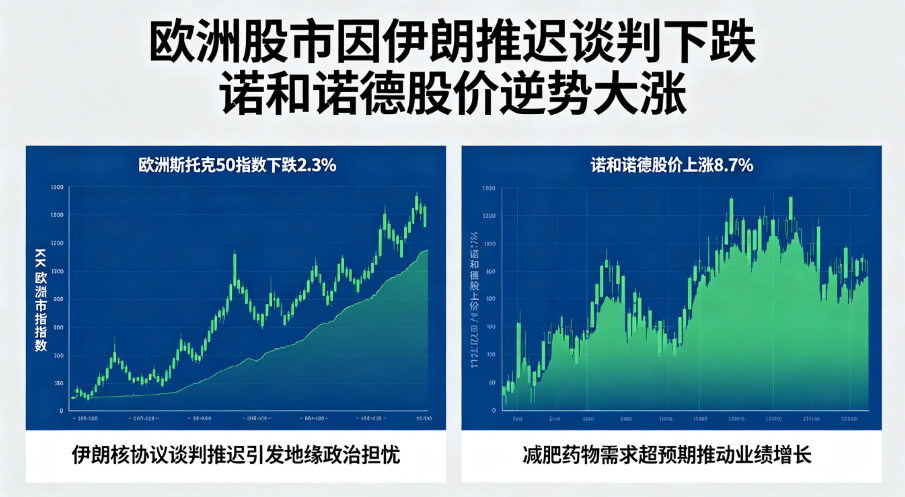
Friday's European stock market was like a traveler suddenly receiving bad news in the afternoon, its originally leisurely pace instantly heavy. The STOXX Europe 600 closed down 0.2%, having briefly gained 0.2% intraday, but that short-lived optimism, like the melting edge of ice cream under a scorching sun, couldn't hold to the close. Behind it all are two keywords stirring the market: Iran and the UK.
Let's put aside the cold numbers and take a lighter look at what drama the market was playing before the weekend.
Geopolitical Seesaw: Iran Talks and Middle East Ceasefire
The market had expected the Memorandum of Understanding signed by US President Trump and Iran's president to launch formal negotiations on a "durable peace agreement" in Switzerland on Friday. This deal was seen by many as a key signal for easing Middle East tensions and lowering oil prices. After all, lower oil prices would allow Europe's manufacturing and consumers dependent on energy imports to breathe, giving stocks a reason to rise.
However, things never go according to script. Suddenly erupted fighting in southern Lebanon cast a shadow over the negotiations. Reports indicated that Israel and Hezbollah agreed to a ceasefire from 4 p.m. local time Friday—but this "fight while talking" model is like playing a game of Russian roulette where no one knows the rules. Market reaction was honest: energy stocks that had risen on peace expectations suddenly became awkward, while risk aversion quietly crept in.
Alexandre Drabowicz, Chief Investment Officer at Indosuez Wealth Management, took a more relaxed view: "Of course, with Trump, things can always deviate along the way, but we believe we are entering a new phase of easing and lower oil prices." Well said, highlighting the unpredictability of the Trump administration while offering a relatively optimistic conclusion. But did investors buy it? Judging from the index's decline, clearly some still have doubts.
This reflects the market's most contradictory point: on one hand, everyone craves a peace dividend, hoping for lower oil prices and cooling inflation; on the other hand, every gunshot in the Middle East reminds us that geopolitical risk has never truly faded. European stocks hit a new high earlier this week due to signs of progress on a peace deal, but Friday's retreat tells us: any "progress" may only be temporary.
By-election Earthquake in UK Politics: Manchester's Butterfly Effect
If Iran is an external threat, internal political changes in the UK are a classic internal worry. Andy Burnham, Mayor of Greater Manchester, won a decisive victory in a by-election, and the significance goes far beyond a local election. Commentators noted this paves the way for him to challenge incumbent Prime Minister Keir Starmer.
You might ask: what does a mayor's by-election have to do with the stock market? Quite a lot. The decline in UK stocks that day was partly due to market reaction to political uncertainty. Burnham is a strong figure within the Labour Party; if he truly challenges Starmer, it could mean a new round of power restructuring in UK politics. For investors, it's like watching a political thriller—you don't know who the next prime minister will be, and his economic policies, Brexit stance, fiscal discipline—all affect the business environment.
Interestingly, UK "political turmoil" has its own rhythm. After the 2016 Brexit referendum, UK stocks plunged but then rebounded due to the pound's depreciation benefiting exporters. While this by-election won't immediately trigger a market crash, it plants a seed of "uncertainty" in investors' minds.
Think of UK politics as a Premier League match—the game is still long, but a key substitute's outstanding performance can change the entire coach's tactics. Burnham is that substitute, and the coach on the field (Starmer) is now under immense pressure.
Sector Divergence: Who's Crying, Who's Laughing?
Looking at European stock sectors, it's a tale of fire and ice. Mining, retail, and consumer stocks suffered the biggest losses—not hard to understand. Mining stocks are closely tied to global economic conditions; Middle East instability plus UK political variables naturally raise doubts about commodity demand. Retail and consumer stocks reflect concerns that consumer confidence might decline, after all, when wallets tighten, who wants to splurge?
Conversely, energy and media sectors performed well. Energy stocks rose—seemingly contradictory: didn't we say a peace deal could push oil lower? But on Friday, delayed talks made the market reassess oil price support. The short-lived Israel-Hezbollah ceasefire wasn't enough to fully eliminate supply disruption risk, so energy stocks became a safe haven for risk-off flows. Media stocks are typically defensive, often seen as a "safe bet" when markets are volatile.
The most notable single stock was Novo Nordisk, which surged 4.6% following an analyst upgrade. This Danish pharma giant has been minting money with its weight-loss drug Wegovy and diabetes drug Ozempic. In times of heightened uncertainty, companies with predictable growth prospects often attract capital. You could say Novo Nordisk is the "model student in turbulent times"—no matter how chaotic the outside world, its products have demand, its earnings are secure.
On the other side, semiconductor equipment giant ASML fell 1.1%. Though the reference didn't detail why, combining recent global semiconductor dynamics, it's easy to guess—continued tightening of US chip export controls on China, plus some chipmakers cutting capex, cast a shadow over ASML's order outlook. This reminds us that geopolitical impacts aren't limited to the Middle East; tech rivalry also directly reflects in stock prices.
Investor's Next Step: Finding Certainty Amid Volatility
The US market was closed Friday for Juneteenth, leaving European stocks without that "anchor." Without US guidance, European investors had to think independently. But sometimes independent thinking is healthier.
The current market consensus seems to be: we are in a phase that is "easing but not too stable." Middle East peace is in sight but the path is winding; UK politics has variables but won't immediately overturn the big picture; inflation data continues to cool, but the timing of Fed and ECB rate cuts remains unclear. Together, these factors mean markets won't soar straight up or free-fall, but will stagger like a drunkard down an alley.
For ordinary investors, the best thing to do in this environment is "stay calm, diversify." Novo Nordisk-style pharma stocks with moats, energy stocks among large oil companies, and some consumer stocks benefiting from a peace dividend—all can be considered. But remember, don't get overly excited about one day's rise or panic-sell on one day's fall.
Interestingly, institutions are quietly raising year-end targets. This suggests professionals think despite short-term volatility, long-term trend remains upward. They have more patience than retail investors and know better when to "be greedy when others are fearful."
Conclusion: Weekend Food for Thought
Friday's European stock market was like a debate with no conclusion. Iran talks, UK by-election, sector seesaw effects—all tell us the market is never a function of a single variable, but a multi-dimensional, multi-layered complex system.
For us ordinary investors, rather than trying to predict tomorrow's direction, take a moment to think: Is your portfolio truly resilient to all surprises? Does your judgment on geopolitics have enough evidence? Will your emotions spiral out of control over a 0.2% move?
This weekend, when you put down your phone, take a look out the window. Red and green candlesticks are fascinating, but what truly determines your long-term returns is never those flickering numbers, but your ability to remain rational in the face of uncertainty.
After all, markets always have tomorrow, and the real winner is often not the fastest runner, but the one who walks most steadily.