
Emerging Market ETF Money Reversal: Why Korea Became a Global Safe Haven?
Introduction
The tides of global capital markets are undergoing a sharp reversal. Last week (ending June 18), US-listed emerging market exchange-traded funds (ETFs) ended the previous week's net outflows, attracting a hefty $2.16 billion in net inflows, the highest weekly rebound in recent times. This reversal not only signals a restoration of investor risk appetite toward emerging markets, but also reveals structural divergence in regional capital allocation—South Korea led with nearly $1 billion in net inflows, becoming the standout "safe haven" in this capital wave. This article provides a multi-dimensional analysis from technical and macro perspectives, delving into the driving logic behind this capital flow phenomenon and the future investment landscape for emerging markets.
From Outflows to Inflows: Triggers of the Reversal
In the week ending June 11, emerging market ETFs saw $1.62 billion in net outflows, with sentiment hitting an ice point. Yet just a week later, capital made a strong comeback with net inflows of $2.16 billion, a swing of $3.78 billion. Such violent short-term swings, superficially a pendulum effect of market sentiment, actually contain deeper structural reasons.
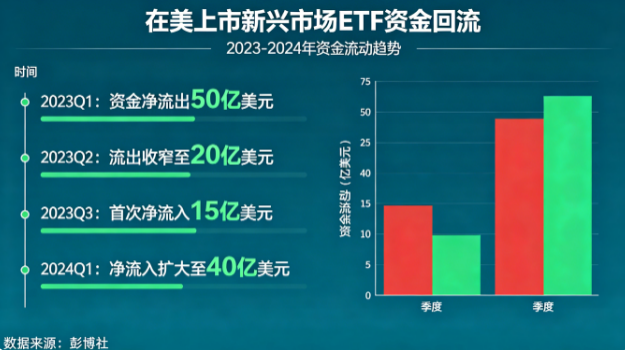
From a technical perspective, ETF flows are often seen as a leading indicator of "smart money." Year-to-date, cumulative net inflows into emerging market ETFs have reached $41.4 billion, indicating long-term funds still favor this asset class. But short-term volatility is more affected by Fed rate expectations, the dollar index, and geopolitical risks. In mid-June, US inflation data came in slightly below expectations, reigniting market hopes for a Fed rate cut within the year; the dollar weakened, directly driving capital from developed markets back to emerging markets.
Additionally, adjustments in policy stimulus expectations for China, policy continuity confirmation after India's election, and structural reforms like South Korea's "Corporate Value-up Program" jointly built fundamental support for inflows. South Korea especially stood out, with ETF net inflows of $993.6 million, accounting for nearly 46% of total emerging market inflows that week. The iShares MSCI South Korea ETF (ticker: EWY) became the largest conduit for capital.
Why Korea Became a Safe Haven?
Korea's market appeal is no accident. From a technical analysis standpoint, Korean equities boast three core advantages:
1. Valuation Discount and Reform Dividends
The Korea Composite Stock Price Index (KOSPI) has long been criticized for the "Korean Discount," with P/E ratios persistently low relative to major global markets. In early 2024, the government launched the "Corporate Value-up Program," encouraging listed companies to enhance shareholder returns through buybacks, dividends, and improved governance. This policy directly triggered foreign revaluation. Data show that after the announcement, net foreign buying in the Korean market continued to increase, particularly in sectors like semiconductors and finance. The massive ETF inflows are a strong endorsement of this structural reform.
2. Leading the Semiconductor Cycle Recovery
South Korea is a core hub in the global semiconductor supply chain, with Samsung Electronics and SK Hynix dominating the memory chip market. As AI computing power demand explodes, high-bandwidth memory (HBM) and other advanced chips face supply shortages, prompting continuous upward revisions in earnings expectations for Korean semiconductor firms. From a technical perspective, the semiconductor sector's earnings growth has rebounded from its trough last year, lifting the entire KOSPI's EPS. Foreign investors use ETFs to gain beta exposure while also capturing semiconductor alpha.
3. Favorable Currency and Interest Rate Mix
The Korean won, after depreciating in 2023, stabilized in 2024. Rising Fed rate cut expectations have narrowed the Korea-US interest rate differential, boosting the won's appeal. Foreign investors buying Korean stocks also gain potential currency appreciation. This dual "stock + currency" return expectation further amplifies ETF attractiveness. From technical flow data, the iShares MSCI South Korea ETF has seen net inflows exceeding $2 billion over the past month, indicating a sustained foreign accumulation trend.
Technical Interpretation of Emerging Market Capital Divergence
Although overall emerging market ETFs saw net inflows, regional divergence was significant. Korea took the lead, while other emerging markets like India, Taiwan, and Brazil performed unevenly. From a technical angle, this divergence reflects the following logic:
- Liquidity Preference: The Korean stock market's daily trading volume, market depth, and ETF product richness are among the best in Asian emerging markets. In periods of rapid capital return, more liquid markets attract large sums more easily.
- Sector Concentration: The performance of heavyweight sectors directly affects ETF flows. Korea's ETF has a semiconductor weight exceeding 30%, and semiconductors are in an upcycle; by contrast, Brazil's ETF is heavy in raw materials and energy, more affected by global commodity price volatility.
- Geopolitical Risk Premium: Although Korea faces Korean Peninsula risks, the market has gradually priced this as a "low-probability tail risk." Other emerging markets like India face election uncertainty, and Taiwan faces cross-strait tensions, requiring higher risk premiums.
Technically, the KOSPI broke through 2700 in May 2024, with trading volume expanding and RSI (Relative Strength Index) staying at 60-70, indicating strong technically driven buying. ETF inflows and the cash market form a positive feedback loop, reinforcing upward momentum.
Conclusion: Structural Significance of Capital Return
Last week's reversal in emerging market ETF flows is not merely a short-term sentiment repair, but a signal for global asset allocation rebalancing. South Korea, with its corporate value reforms, semiconductor cycle recovery, currency stability, and high liquidity, has become the top destination for capital. This trend is likely to continue in the near term, especially as the timing of the Fed's rate cut approaches, making the interest rate advantage of emerging markets over developed markets reappear.
However, investors must also be cautious of potential risks: a sharper-than-expected downturn in the semiconductor cycle, rising global trade frictions, or increased domestic political uncertainty in Korea could trigger renewed outflows. Technically, current ETF inflows are near historical highs, with short-term profit-taking pressure. But for long-term capital, Korea still offers structural appeal—valuation recovery, improved shareholder returns, and long-term AI chain demand are core logics supporting sustained foreign inflows.
Overall, emerging market ETF flows have switched from "risk-off mode" to "selective mode." South Korea, as a core target in this round of regional allocation, deserves sustained attention for its capital absorption effect. In the context of global capital flows, those who seize opportunities from structural reform and industrial cycle resonance will become winners in the next wave of capital.