Precious Metal Investment: A New Era of Hedge Demand and Strategic Value
Against the backdrop of global financial market instability, precious metals, as traditional safe-haven assets, have once again become the focus of investors. Whether it's the enduring allure of gold or the dual industrial and financial attributes of silver, platinum, and other metals, these precious metals play an irreplaceable role in the current economic environment. This article delves into market dynamics and investment value of precious metals, analyzing future development potential in light of recent market events.
Global Risk Aversion Heats Up, Driving Gold Prices Higher
In recent years, geopolitical tensions, inflationary pressures, and monetary policy uncertainty have continuously fueled risk aversion. As the classic safe-haven tool, gold's price trend often shows a negative correlation with market risk appetite. When stock markets experience sharp volatility, capital tends to flow into the gold market to hedge against potential losses. For example, the recent plunge in US ETFs tracking the semiconductor sector and the astonishing rise of 3x short semiconductor ETFs reflect market concerns about tech stock prospects. In this context, gold's appeal has significantly increased, as it is not affected by the performance of a single industry or company.
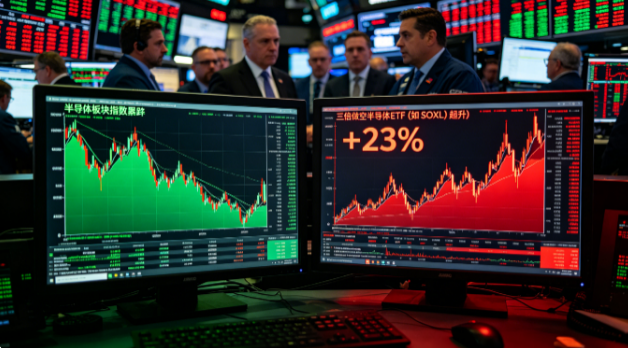
As the chart above shows, when the semiconductor ETF plunged, short-related ETFs rose by over 23%. This not only reveals extreme market panic but also indirectly demonstrates the upside potential of safe-haven assets like gold. The trend of investors moving from high-risk assets to gold is particularly evident amid such market volatility.
Silver: The Interplay of Industrial Demand and Precious Metal Attributes
Compared to gold's purely financial nature, silver has more complex market drivers. Silver is not only a safe-haven asset but also an indispensable raw material in modern industry, especially widely used in solar panels, electronics, and medical devices. With the acceleration of green energy transition, industrial demand for silver is expected to continue growing. However, silver's price volatility is typically higher than gold's, meaning it offers higher return potential but also comes with corresponding risks.
In the current macroeconomic environment, silver's dual nature makes it an intriguing investment target. When industrial production recovers, silver prices may benefit from increased demand; when market risk aversion rises, it can attract capital inflows like gold. Investors should closely monitor global manufacturing data and renewable energy policies to assess silver's long-term value.
Platinum Group Metals: Rarity and Strategic Value
Platinum, palladium, and rhodium, among other platinum group metals, have long been valued for their rarity and critical role in automotive catalytic converters. The prices of these metals are heavily influenced by automotive industry demand, mine supply, and environmental regulations. In recent years, with the rise of electric vehicles, demand for palladium and rhodium may face challenges, but platinum's potential in hydrogen fuel cell technology brings new growth opportunities.
Additionally, the supply chain for PGMs is relatively concentrated, primarily from South Africa and Russia, making them more sensitive to geopolitical risks. Any supply disruption could lead to sharp price fluctuations, creating opportunities for astute investors. For those seeking to diversify portfolios and bet on emerging technologies, PGMs merit in-depth research.
Investment Strategies and Risk Management for Precious Metals
In the current uncertain environment, investing in precious metals is not without risks. Price volatility, changes in market liquidity, and exchange rate risks are factors investors need to consider. Therefore, establishing a balanced investment strategy is crucial. For example, hold gold as a core position to stabilize the overall portfolio; allocate silver or platinum to capture potential gains from industrial recovery or technological innovation. Using exchange-traded funds (ETFs) for investment can reduce storage and insurance costs of holding physical metals while providing good liquidity.
Furthermore, investors should remain flexible, adjusting positions based on macroeconomic indicators and market sentiment. When markets experience extreme volatility, such as the plunge in semiconductor ETFs, it may signal increasing precious metal allocation. Conversely, when risk appetite rebounds, appropriately reduce holdings to lock in profits.
Conclusion: The Enduring Value and Epochal Opportunities of Precious Metals
Precious metals are not only symbols of wealth but also indispensable safe-haven tools in financial markets. Amid multiple shocks from global economic transformation, geopolitical turmoil, and monetary policy changes, the investment value of gold, silver, and platinum group metals becomes increasingly prominent. From short-term hedge demand to long-term strategic allocation, precious metals offer diverse options for investors.
Looking ahead, with the development of new technologies and reshaping of the global economic landscape, the precious metal market will continue to evolve. Investors who can discern these changes and adopt prudent investment strategies will have the opportunity to seize opportunities amidst uncertainty, achieving wealth preservation and growth. The eternal brilliance of precious metals will continue to shine in the tides of the times.