
Precious Metals Market New Trends: Emerging Market ETF Capital Return and Safe-Haven Demand Align
Keywords
precious metals, emerging market ETF, capital inflow, safe-haven assets, gold, silver, central bank gold purchases, inflation expectations
Introduction
After experiencing cyclical fluctuations and geopolitical uncertainties, global financial markets are showing new structural characteristics. Precious metals, as traditional safe-haven assets and monetary anchoring tools, have price trends closely tied to macroeconomic variables, investor sentiment, central bank policies, and capital flow directions. Recently, US-listed emerging market ETFs have shown a notable rebound in capital inflows. This phenomenon not only reflects a repricing of global capital toward emerging economies' growth prospects but also reveals underlying changes in precious metals demand. This article provides a professional analysis of the current pattern and future trends in precious metals markets from dimensions including capital flows, macro drivers, supply-demand balance, and institutional behavior.
1. Implications of Emerging Market ETF Inflows
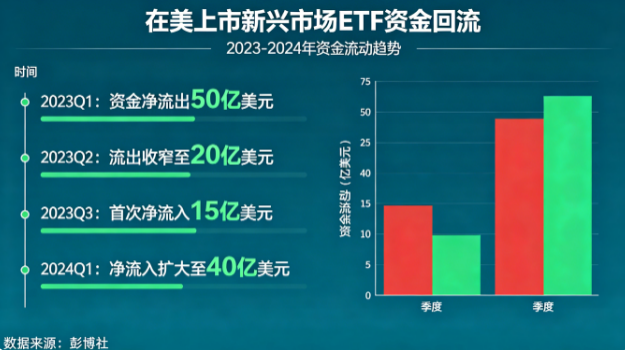
As shown above, US-listed emerging market ETFs recorded a clear rebound in net capital inflows in the recent period. This capital behavior typically coincides with a recovery in global risk appetite, a phase of dollar weakening, and expectations of emerging market currency appreciation. For precious metals, ETF inflows into emerging markets carry dual signal significance.
First, emerging markets are important consumption and production regions for gold, silver, and other precious metals. Countries such as India, China, and Turkey account for over half of global physical gold demand. When global capital re-enters emerging markets, it suggests improved expectations for residents' disposable income, inflation environments, and monetary stability, thereby driving physical consumption demand for jewelry, bars, and coins. Second, ETF inflows into emerging markets are often accompanied by intensified diversification strategies of emerging-market central banks' foreign exchange reserves. In recent years, many central banks have continued to increase gold holdings to reduce reliance on dollar assets, a behavior reflecting long-term judgments about the restructuring of the global economy.
2. Analysis of Precious Metal Price Drivers
2.1 Real Interest Rates and Inflation Expectations
The core pricing logic for precious metals, especially gold, revolves around real interest rates. When nominal rates fall faster than inflation expectations, real rates decline, lowering the opportunity cost of holding gold and supporting prices. Currently, while inflation data in major economies have retreated from peaks, core inflation remains sticky, with services price stickiness particularly pronounced. At the same time, major central banks such as the Fed have entered a rate-cutting cycle or are in a policy transition observation period, opening space for declining real rates. In such a macro environment, precious metals as a tool to hedge against purchasing power erosion see their allocation value highlighted again.
2.2 Geopolitical Risk and Safe-Haven Premium
The ongoing Russia-Ukraine conflict, Middle East tensions, and frequent escalation of global trade frictions make geopolitical risk premium an indispensable component of precious metal prices. Historical experience shows that in the six months to a year after a major geopolitical event, gold's average gain often exceeds 10%. Notably, risk-averse behavior in the modern financial system is not limited to physical gold; gold ETFs, futures, and options markets also carry substantial safe-haven capital. The risk appetite recovery represented by emerging market ETF inflows may actually coexist oddly with safe-haven demand—investors increase their exposure to emerging market equities while simultaneously increasing precious metal allocations to hedge tail risks. This prevalence of the "barbell strategy" is driving precious metal demand upward amid volatility.
3. Risk Aversion and Central Bank Gold Buying Behavior
3.1 Structural Trend of Central Bank Gold Purchases
According to the World Gold Council, global central banks have remained net buyers for many consecutive years, with purchases at historically high levels. Important buyers include the People's Bank of China, the National Bank of Poland, and the Reserve Bank of India. The motives for central bank gold purchases have shifted from mere asset allocation to strategic "de-dollarization" and financial security system construction. With rising holding costs of US Treasuries and precedents like the freezing of Russian central bank assets, more emerging-market central banks are accelerating gold reserve accumulation. This behavior not only directly increases physical gold demand but also reinforces gold's monetary properties at the confidence level.
3.2 Linkage Effect Between Capital Inflows and Central Bank Behavior
A positive feedback mechanism exists between emerging market ETF inflows and central bank gold buying. When foreign capital flows into emerging markets, the local currency often appreciates, and in managing exchange rates, central banks may absorb liquidity by purchasing gold while adjusting foreign reserve structures. Moreover, the economic growth expectations fueled by capital inflows drive up inflation expectations, giving central banks more incentive to add gold to stabilize currency purchasing power. Therefore, the recent rebound in US-listed emerging market ETF inflows likely signals that central bank gold purchases will remain elevated in coming quarters, providing long-term fundamental support for precious metal markets.
4. Supply-Demand Dynamics and Price Outlook
4.1 Supply-Side Bottlenecks
On the supply side, global gold mine production has entered a period of low growth or even stagnation. Grade decline at major gold mines, long investment cycles for new projects, and higher approval thresholds have reduced supply elasticity. For silver, most production is a byproduct of base metals like copper, lead, and zinc, with output heavily influenced by base metal prices and limited independent expansion capacity. These structural supply constraints mean that when demand-side marginal improvement occurs, precious metal prices are more prone to larger upward swings.
4.2 Diversified Demand Side
Beyond investment and central bank demand, industrial application growth is also significant. Silver usage in photovoltaics, electronics, electric vehicles, and other fields continues to climb. With the global energy transition accelerating, silver's industrial demand share has exceeded 50%. Gold's applications in semiconductor packaging, medical devices, and other advanced technologies are also expanding. This demand diversification reduces precious metal price sensitivity to any single factor, enhancing price resilience.
4.3 Short-Term Volatility and Long-Term Trend
In the short term, precious metal prices may face pullbacks due to a dollar rebound, sharp risk appetite recovery, or repeated Fed policy expectations. However, from a medium-term perspective, the onset of a global monetary easing cycle, inflation stickiness, and persistent geopolitical uncertainties will jointly support prices. Combined with capital flow trends reflected in emerging market ETF inflows, gold and silver are expected to gradually rise in a volatile range.
Conclusion
Based on the above analysis, global precious metal markets are at a critical stage interwoven with bullish and bearish factors. The rebound in US-listed emerging market ETF inflows is not only a signal of improving risk appetite but also points to potential growth in emerging economies' demand for precious metals. Under the combined effect of declining real interest rates, sustained central bank gold buying, limited supply growth, and expanding industrial demand, the long-term allocation value of precious metals is significant. Investors and policymakers should closely monitor changes in emerging market capital flows as a leading indicator for marginal changes in precious metal demand. Looking ahead, precious metals will not only serve as tools for hedging inflation and risk but also play an irreplaceable role in the reshaping of the global monetary system.